各校計畫成果
國立成功大學玉山青年學者王靖興教授第二期第2年期中計畫成果
活動簡介
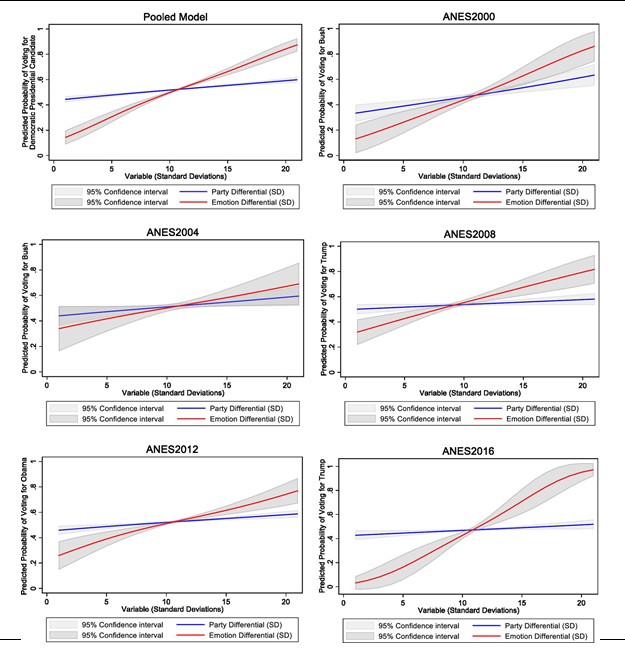
我們利用2000年到2016年美國國家選舉研究資料,檢驗理性與情緒對投票選擇之影響。結果顯示,選民同時受政策評估與情緒反應影響,且情緒因素之影響力高於理性考量。
Using data from the 2000–2016 American National Election Studies, we examine the relative effects of rational evaluation and emotional response on vote choice. The findings show that voters consider both policy differences and affective reactions, with emotions exerting a stronger influence than rational considerations.
我們嘗試整合理性選擇理論與情緒政治研究兩大取向,探討理性認知與情緒反應在個人投票選擇中的相對影響。過去文獻多偏重理性計算或情緒動員其中之一,較少同時納入兩種機制進行系統性比較。我們使用2000年至2016年美國國家選舉研究(American National Election Studies)資料,建構「政黨差距」作為理性評估指標,以及「情緒差距」作為情緒取向指標,透過統計模型估計兩者對投票決策之影響。
實證結果顯示,選民在投票時確實會同時考量不同政黨之政策立場差異與其對候選人的情緒反應,顯示理性與情緒並非互斥,而是共同運作。然而,在控制其他因素後,情緒差距對投票選擇的影響力顯著高於理性評估指標,顯示情緒在選舉決策中具有更強的解釋力。
本研究的貢獻在於,透過實證資料證明投票行為並非純粹理性計算結果,也非單純情緒動員,而是兩者交織的產物。研究結果進一步指出,若投票模型忽略情緒因素,將可能低估或錯誤理解選民行為的形成機制。此發現對政治行為理論與選舉研究具有重要啟示,也為未來整合理性與情緒之投票模型提供實證基礎。
We attempt to integrate two major perspectives in the study of voting behavior – rational choice theory and the politics of emotion – by examining the relative impact of cognitive evaluations and affective responses on individual vote choice. While previous research has demonstrated that both rational calculation and emotional attachment can shape electoral decisions, few studies have systematically assessed their effects simultaneously within a unified empirical framework. This study addresses that gap.
Using data from the 2000–2016 American National Election Studies (ANES), we constructed two key explanatory measures: a party differential to capture rational evaluations of policy positions and a candidate emotion differential to measure affective orientations toward competing candidates. Statistical models were employed to estimate the independent and relative effects of these two mechanisms on individual voting decisions.
The results show that voters incorporate both policy-based evaluations and emotional reactions when making electoral choices. Rational and affective factors operate simultaneously rather than exclusively. However, after controlling for relevant covariates, affective orientations exhibit a substantially stronger effect on vote choice than rational considerations. These findings underscore the central role of emotion in shaping political preferences and suggest that voters are not purely calculating actors.
The contribution of this study lies in demonstrating empirically that voting behavior is best understood as the product of intertwined cognitive and emotional processes. Models that omit or downplay affective considerations risk offering incomplete or underspecified explanations of electoral behavior. By providing systematic evidence of the comparative influence of affect and rationality, this research advances theoretical debates in political behavior and contributes to a more comprehensive understanding of democratic decision-making.
 回上一頁
 回首頁